admin
2026-11-02 | 0 comments
Share this:
Contents
The best wall insulation materials in Ukraine help reduce heat loss; however, a poor choice can lead to dampness and the need for repairs to the interior or exterior finishes. It is important to consider more than just heating costs: insulation affects wall moisture levels, indoor comfort, and the lifespan of the facade.
There is no single "universal" material. The right choice depends on the wall material—whether it is brick, concrete, blocks, or wood—as well as the facade design, your budget, and fire safety requirements. Below, we will compare popular options, examine key parameters, and provide a brief checklist to review before making a purchase.
A material that performs well on one type of facade may be entirely unsuitable for another. Before making a purchase, evaluate the wall construction, the installation method, and the conditions inside the building.
This will help avoid problems that cannot be fixed simply by replacing a single layer of the finish.Brick, concrete, block, and timber walls conduct heat and moisture differently. Inspect the surface for cracks, crumbling areas, or signs of mold. If a wall is damp, first identify the cause—such as a leak, a faulty drainage system, rising damp, or poor ventilation.
The substrate must be sound and properly prepared. Uneven areas, dust, or loose, crumbling plaster will prevent the insulation from adhering securely. Any defects must be repaired before installation; they should not simply be covered up by insulation boards.
External insulation typically protects the wall from the outside while preserving the usable floor area inside the rooms. It is essential to select a compatible system, including the insulation material, adhesive, fasteners, reinforcing layer, and finish. All materials must be compatible with one another and with the substrate.
Internal insulation requires careful calculation. Changes in wall temperature can lead to moisture accumulation within the structure. Before starting work, assess the risk of condensation and ensure the rooms are adequately ventilated.
In Ukraine, calculations depend on the temperature zone and the building's intended use. The standard DBN V.2.6-31:2021 specifies the minimum thermal resistance for the external walls of residential and public buildings: 4.00 m²·K/W for the first temperature zone and 3.50 m²·K/W for the second. Note that this figure refers to the entire wall assembly, not just the thickness of the insulation material.
Current documents are listed in the Ministry of Infrastructure’s section on active building codes; tables and requirements can be found in DBN V.2.6-31:2021.Thickness should not be determined "by eye" or by copying what your neighbors have done. It depends on the wall material, the local climate, and thermal bridges at various points in the building structure. Always consult current building codes and your project documentation when performing calculations.
Do not base your comparison solely on thermal conductivity. For facades, other critical factors include moisture resistance, vapor permeability, fire safety properties, durability, and compatibility with the chosen exterior finish. Check the technical data sheet for the specifications of a particular brand.
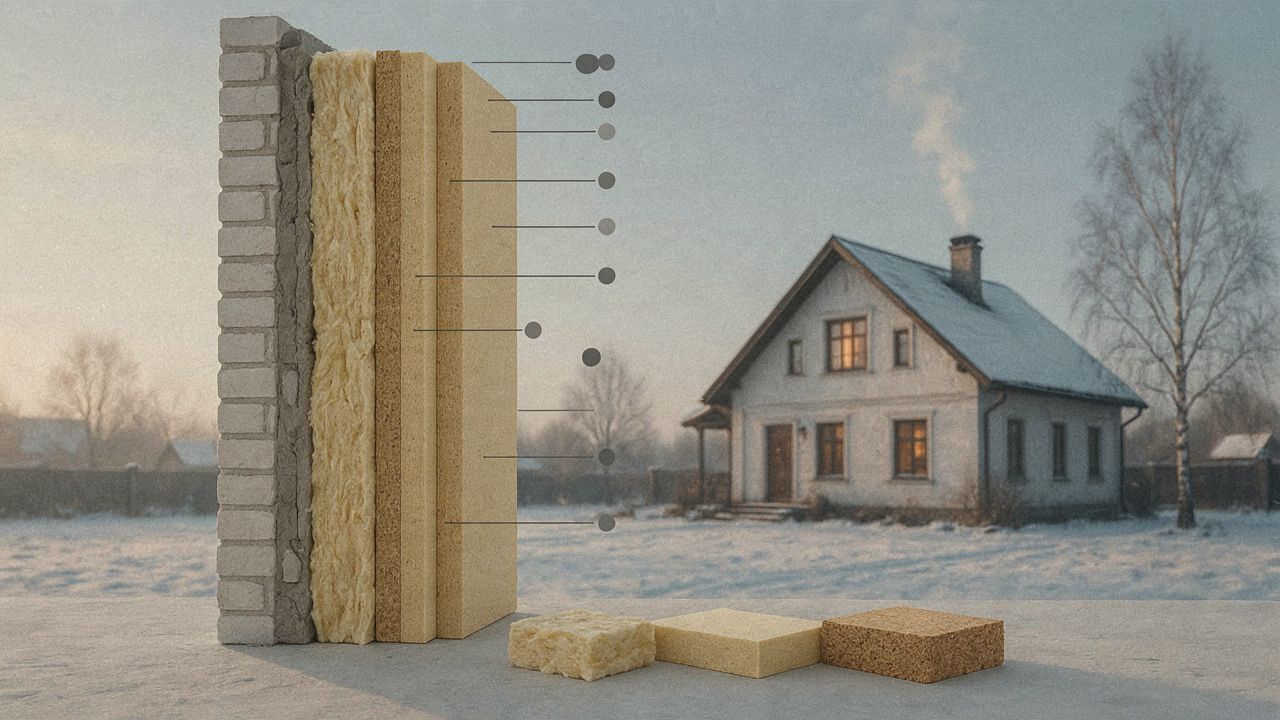
Facade panels made of stone or glass wool are used in both external plaster (stucco) systems and ventilated facade systems. While this material can improve sound insulation, the final result depends on the entire wall assembly and the installation method. For a facade, ensure you select panels specifically designed for the system you are using.
Mineral wool must be protected from moisture during storage and installation. It should be installed without gaps, in accordance with the required fastening methods and system specifications. If the material becomes wet, it must not simply be covered over with a finish; you must first verify whether it has retained its necessary properties.
Expanded polystyrene (EPS) is commonly used in external plaster (stucco) facade systems. It is lightweight and easy to handle processing, and it is generally less expensive than many mineral wool facade panels. However, the appropriate grade depends on the substrate, the specific project, and the system being used.
Always verify the intended use of the panels and their fire classification. Polymer-based insulation should not be selected in isolation from the rest of the facade assembly; factors such as protective layers, detailing around windows, and specific application limitations are critical. Follow the instructions provided by the system manufacturer.
Extruded polystyrene (XPS) is often chosen for areas where high strength and moisture resistance are required, such as plinths (base sections of a wall). It is not always suitable for an entire wall, as its vapor permeability properties differ, and the facade system must be specifically engineered to accommodate such a material.
Wood-fiber boards, cellulose insulation, and cork are considered alternative solutions. These may have specific requirements regarding moisture and fire protection. Always check the technical specifications, intended scope of application, and documentation for the specific product.
Compare values taken from the technical data sheets for a specific product grade, rather than relying on marketing claims made for an entire category of materials. Verify the conditions under which the data was obtained and the installation method for which the product is intended. For a facade, evaluate the performance of the entire assembly.
Thermal conductivity indicates how effectively a material conducts heat. A lower value means that less heat passes through a layer of a given thickness. However, this is not the only parameter; the overall result is also influenced by the wall itself, fasteners, joints, and the areas around windows.
The required thickness is determined based on calculations for the entire wall assembly and in accordance with local building codes and standards.
The same layer can yield different results depending on whether the substrate is concrete or brick. For complex structures, have a specialist perform the calculations.A wall and its insulation function as a single integrated system. If the layers are not selected correctly, moisture can accumulate inside, causing the finish to peel off. The level of risk depends on indoor humidity, ventilation, and how well the facade is protected from rain.
Inspect the junctions where the insulation meets windows, doors, the roof, and the plinth (base). Even the most suitable material cannot prevent leaks or chronic dampness. For interior insulation or old, damp walls, a hygrothermal (heat and moisture) analysis is required.
Check the documentation for product labeling, intended use, technical specifications, and certificates of conformity. For residential buildings, it is crucial that both the insulation material and the entire facade system meet fire safety requirements. Compare these against your project specifications and current building codes (including relevant fire safety regulations).
Do not rely on generic descriptions from a retailer’s website in place of official product documentation. If the technical data sheet lacks necessary information, request it from the seller or manufacturer. For multi-unit residential buildings, be sure to check for any specific restrictions that may apply to the facade.
The price per package does not reflect the total cost. The budget must account for substrate preparation, fasteners, reinforcement, finishing, and labor. Installation errors can negate the benefits of even the highest-quality insulation.
Ensure the estimate includes the insulation, adhesive, fasteners (dowels), mesh, primer, reinforcing layer, and finishing materials.
Compare proposals that include the same scope of work and materials. Otherwise, a low price might simply mean that essential components have been left out.Verify which components are part of a specific system and whether they are approved for use together. Pay particular attention to the areas around windows and doors; gaps and thermal bridges often appear in these spots.
The substrate must be level and structurally sound. Insulation boards should be installed tightly, with staggered joints and no gaps extending through the layer. Connections to openings and the plinth (base) must be executed according to the project specifications.
Before selecting a contractor, examine their completed projects and find out exactly what the warranty covers. It is also helpful to look at facades on buildings with similar wall structures and in similar climates—a successful result on one building does not guarantee the same outcome on another.
First, define your requirements: are you insulating from the outside or the inside? What is the wall material, and what is the current condition of the facade? Next, select an appropriate system and calculate the required insulation thickness. Following this sequence helps ensure you don’t waste money on insulation that isn’t suitable for your building.
For a private home with an exterior stucco finish, you might compare mineral wool facade insulation with EPS (expanded polystyrene). For the plinth or areas exposed to moisture, XPS (extruded polystyrene) is often considered—but only if it is specified in the project design. For multi-unit residential buildings, fire safety requirements and the use of a certified, integrated system are the top priorities.
When considering interior insulation, first calculate moisture levels and assess the ventilation system. For timber walls, it is especially important to account for vapor movement and protection against precipitation.
Do not apply a solution designed for a brick house to a wooden one without verification.Common mistakes include purchasing without verifying documentation, using arbitrary insulation thickness, or mixing components from different systems. Furthermore, issues such as cracks, dampness, or fire safety restrictions must not be overlooked. Cutting corners on a project can ultimately lead to the need for a complete facade overhaul.
Before making a payment, check the product labeling, the technical data sheet, and a detailed cost estimate. Clarify who is responsible for the quality of the work and the warranty. If the wall is damp or the structure is complex, consult with the project designer regarding the appropriate solution.
The best insulation is the one specifically suited to your particular wall. The choice depends on the wall material, the facade design, the local climate, and fire safety requirements. Compare technical documentation, calculate the required thickness for the entire assembly, and take into account the total cost of installation.
Before purchasing, inspect the substrate and obtain a cost estimate that lists every individual component. This is the best way to ensure you select an insulation system that will provide long-lasting performance.
Previous article
Stylish solutions for small apartments: design ideas that save space
Next article
Moving near Kyiv experience : the pros and cons of living outside the city
Want to stay up-to-date on all the latest news in construction, design, renovation, and energy efficiency? Subscribe to the Kedr News Telegram channel.
 subscribe