admin
2026-02-08 | 0 comments
Share this:
Do you spend a lot of money on heating in winter, and your house is stuffy in summer? This is a familiar problem for many homeowners. Facade insulation helps you save on utilities and live comfortably all year round.
Today we'll look at two popular materials: polystyrene foam (also known as extruded polystyrene foam or EPS) and mineral wool (stone wool). The choice between them affects the warmth in your home, safety, and even your budget. Let's figure out which one is right for you.
Thermal conductivity coefficient λ shows how much a material transmits heat. The lower this number, the better it retains heat. For standard-density foam plastic (15-30 kg/m³), λ is usually 0.030-0.040 W/(m K). Mineral wool with a density of 100-150 kg/m³ gives 0.035-0.045 W/(m K).
Foam plastic wins slightly in this indicator if a thin layer of insulation is needed. But the difference is small. In cold regions, both materials will cope if the thickness is chosen correctly. Select a value based on your climate.
Vapor permeability determines how well a wall allows moisture to pass through. This is important to prevent mold. Foam plastic has a high Sd value—it barely breathes, with an Sd value of approximately 0.5-1 m. Mineral wool allows vapor to pass through better, with an Sd value of 0.02-0.1 m.
For brick walls, mineral wool is ideal—moisture escapes and there is no condensation. However, for aerated concrete, foam plastic can create a vapor trap if ventilation is not provided. Think of a wall as skin: mineral wool allows it to breathe, while foam plastic is like a thick film. If the house is old and has wooden walls, mineral wool will reduce the risk of mold.
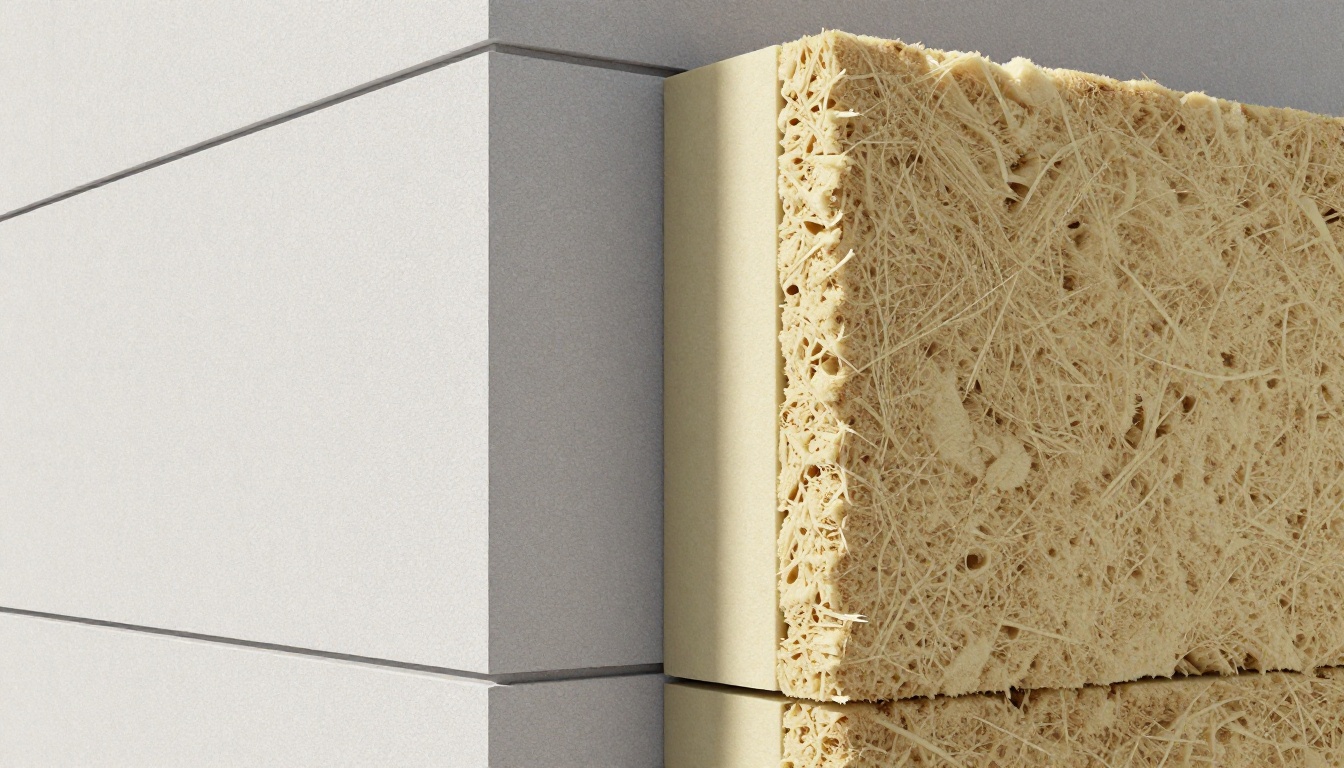
The density of polystyrene foam is 15-35 kg/m³; it is lightweight, weighing only 1-2 kg per slab. Mineral wool is denser, 80-200 kg/m³, and weighs 5-10 kg per m³. Lightweight polystyrene foam is good for dilapidated buildings—it doesn't put a strain on the foundation.
Mineral wool withstands impacts better and doesn't crumble in the wind. For multi-story buildings or houses with a weak frame, polystyrene foam is easier to install. However, if the façade is subject to mechanical stress, as in urban areas, mineral wool is more reliable. Choose according to your home type.
Fire is the main concern when insulating. Foam plastic is flammable, class G3-G4, but modern types are self-extinguishing. It adds combustible mass, which is bad for facades higher than the 5th floor. Mineral wool is non-flammable, class A1 - completely non-flammable.
According to DBN B.1.1-7:2016 standards, mineral wool is mandatory for ventilated facades. Fire spreads quickly in foam plastic, like in a matchbox. If safety is a top priority, choose mineral wool.
Statistics show that 70% of facade fires are caused by flammable insulation materials like polystyrene foam.
Mineral wool is resistant to rodents and insects - mice don't chew its fibers. Low-density polystyrene foam attracts rats, who chew it to make nests. Mineral wool is also more resistant to chemicals, such as aggressive cement in plaster.
Foam plastic can degrade from UV rays if not sealed immediately. Mineral wool is not affected by alkalis. In damp areas, such as near a river, mineral wool will prevent mold problems. Add a water repellent for both, but mineral wool is easier to maintain.
Wind and temperature changes put pressure on the facade. Foam plastic is rigid, but cracks in severe frost. Mineral wool is flexible, absorbing shocks - like a spring against a rigid board.
Fasten the foam plastic with umbrella dowels at 5-6 points on the slab to prevent tearing. For mineral wool, use a full adhesive fill and anchors. In snowy areas, mineral wool is less deformed by frost.
According to test results, foam plastic shrinks by 1-2% over 10 years, mineral wool - almost none.
Foam plastic is suitable for wet facades (EIFS) - it is glued and plastered. Mineral wool is the star of ventilated systems where an air gap is needed. Both work in EIFS, but for mineral wool, use special solvent-free adhesives.
In a ventilated facade, mineral wool does not accumulate moisture. Foam plastic in such a system requires a vapor barrier. If you are building a wet facade on foam plastic, use a reinforcing mesh. For mineral wool in a ventilated system, use a metal frame. Choose a system that suits your budget: EIFS is 20% cheaper.
Prepare the wall: clean it of dust and dirt for both. Foam plastic forgives irregularities up to 2 cm; glue it to 40% of the area. Mineral wool requires a flat surface - full adhesive coverage plus 5-8 anchors per m².
For old walls under mineral wool, level with plaster. Foam plastic is easier to install on uneven surfaces. Always check the level, otherwise it will fall off. In rainy weather, expect dry weather: mineral wool absorbs water, polystyrene foam does not.
Cut polystyrene foam with a knife - quickly, 1-2 hours per room. It is lightweight, two people can do it. Mineral wool can be cut with a saw, but it creates dust - you need protection. Installation of mineral wool takes 20% longer due to its weight.
Foam plastic is easier to transport, it does not wrinkle. Mineral wool is resistant to damage at the construction site. If the team is experienced, the difference in speed is small. Start with polystyrene foam; if you are in a hurry, you will save a day.
For a 100 mm layer with R=3, polystyrene foam costs 100-200 UAH/m². Mineral wool - 150-300 UAH/m². The difference is 30-50% at the start. But polystyrene foam is thinner, so the coverage area is similar.
Prices fluctuate in stores, but mineral wool is more expensive due to production. For a 100 m² house, save 10-15 thousand on polystyrene foam. Calculate for your region - in Kyiv it is 20% more expensive.
Polystyrene foam lasts 25-30 years, mineral wool - 50+. Savings on heating: both provide a 30-40% reduction in bills. But if polystyrene foam gets wet, repairs will cost 2-5 thousand UAH/m².
Mineral wool requires repairs less often - there is less moisture. Mineral wool pays for itself in 20 years due to its durability. In calculations: invest in mineral wool if the house will last for centuries. Foam plastic for a summer house is cheap and cheerful.
Insulating a facade with foam plastic or mineral wool is a matter of balance between price, safety, and comfort. Foam plastic is cheaper and lighter, but weaker in fire and wall breathing. Mineral wool wins in durability and fire protection, although installation is more difficult.
Here's a quick guide:
Always consult technical specifications for your climate and systems from the manufacturer, like Knauf or Rockwool. Don't take risks - the right choice will save you thousands. Start with measurements: call a specialist and do the math. Your home deserves the best insulation!
Previous article
How to choose the right flooring for a child's room: safety, eco-friendliness, and durability
Next article
Building and Renovating a House in Ukraine in 2026: A Complete Guide to Investments and Technologies
Want to stay up-to-date on all the latest news in construction, design, renovation, and energy efficiency? Subscribe to the Kedr News Telegram channel.
 subscribe